
Survey: Half of Muslims in France Support Sharia Law
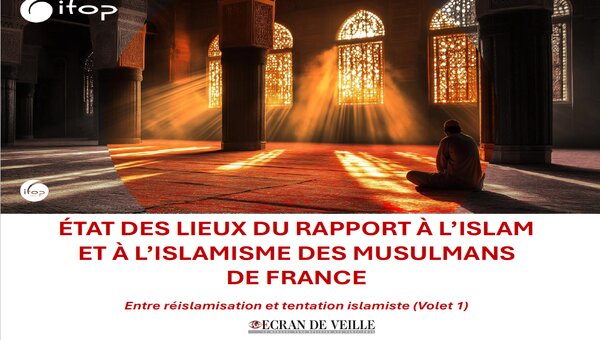
A research survey shows that young Muslims in France are markedly more religious than their parents and exhibit a level of religiosity well above that of other religions.
Survey: Half of Muslims in France Support Sharia Law
Soeren Kern | Ideological Defense Institute | March 17, 2026
A research survey shows that young Muslims in France are markedly more religious than their parents and exhibit a level of religiosity well above that of other religions. The report also shows intensifying support for Islamism, the belief that all social and political systems should be guided by Islam. For example, nearly half (46%) of all Muslims in France believe that Islamic law (sharia) should be applied in France, according to the study.
The survey—An Assessment of the Relationship Between Muslims in France and Islam and Islamism—was conducted by the French Institute for Public Opinion (Institut français d’opinion publique, IFOP), a major polling and market research firm based in Paris. The poll is unique because it seeks to measure the evolution of the religiosity of France’s Muslim population over the past 40 years.
Some of the survey’s key findings include:
- Eight out of ten (80%) of all Muslims in France say they are “religious,” compared with 48% on average among followers of other religions. Young Muslims (ages 15–24) are particularly religious: 87% say they are devout.
- Nearly one-quarter (24%) of Muslims in France say they are “extremely” or “very” religious, compared to 12% on average among followers of other religions. Among young Muslims, 30% say they are intensely religious. According to the report, this “over-religiosity” among Muslims as generations change “completely reverses the classic patterns of secularization.” This strengthening of religiosity is “primarily part of a process of religions re-affiliation of a segment of Muslim youth to a traditionalist form of Islam.”
- Mosque attendance has risen sharply over the past 40 years, especially among young Muslims. Weekly mosque attendance has increased to 35% in 2025 from 16% in 1989; daily prayer practice has increased to 62% in 2025 from 41% in 1989.
- In 2025, nearly three-quarters (73%) of Muslims in France in observe Ramadan, compared with 60% in 1989. In 2025, among young Muslims, 83% say they observe Ramadan.
- In 2025, more than one-third (38%) of Muslims in France support Islamism, a proportion twice as high (19%) as those who supported Islamic fundamentalism thirty years ago (1998).
- In 2025, one-third (32%) of young Muslims in France say they support the ideology of the Muslim Brotherhood, which seeks to Islamize Western civilization.
- In 2025, nearly half (46%) of Muslims in France believe in the application of Islamic law (sharia). Furthermore, 44% prioritize sharia over French laws on issues such as ritual slaughter or inheritance, compared to 16% in 1995.
The report concludes:
“This survey paints a clear picture of a Muslim population undergoing a process of re-Islamization, structured around strict religious norms and increasingly tempted by an Islamist political project.
“Instead of following the usual pattern of secularization, Muslims in France—especially among the younger generation—are witnessing a strong reaffirmation of their identity through the intensification of religious practices, the rigidification of gender relations, and growing adherence to Islamist theses.
“What is most striking about these results is the consistency of the generational gradient: on almost every indicator (religiosity, religious practices, headscarves, rejection of gender mixing, rejection of science, primacy of religious law, adherence to Islamism), young Muslims consistently demonstrate greater rigor and radicalization than their elders. This trend suggests that, far from diminishing over time, the process of re-Islamization will, on the contrary, increase with each generational shift.
“It remains to be seen whether this dynamic is reversible. The survey suggests that, at this stage, nothing appears to be halting this process of re-Islamization. On the contrary, all indicators point to a strengthening of these trends in the years to come. In this context, the question of the integration of Muslims in France and their adherence to republican values has taken on a new urgency, calling for political responses that go far beyond security-based or repressive approaches.”
Soeren Kern is a fellow at the Ideological Defense Institute.