Dutch Parliament Approves Motion to Ban Muslim Brotherhood
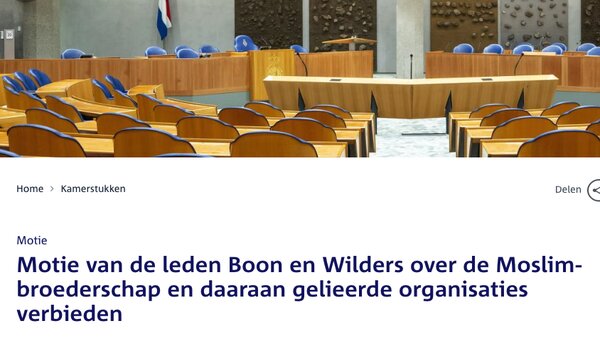
The Dutch Parliament has narrowly approved a motion to ban the Muslim Brotherhood, a transnational Islamist group that seeks to establish a global Islamic Caliphate.
Dutch Parliament Approves Motion to Ban Muslim Brotherhood
Soeren Kern | Ideological Defense Institute | March 19, 2026
On March 17, the Dutch Parliament narrowly approved a motion to ban the Muslim Brotherhood, a transnational Islamist group that seeks to establish a global totalitarian caliphate (Islamic empire) and is enjoying huge success in entrenching autonomous parallel Islamic societies in Europe and other parts of the West.
The vote in the House of Representatives (Tweede Kamer) was 76 in favor and 74 against. The measure was submitted to parliament on March 9 by the Freedom Party (Partij voor de Vrijheid, PVV), a civilizational party led by Geert Wilders.
The motion cited a May 2025 intelligence report by the French Interior Ministry which revealed the extent to which France is being infiltrated from within by the Muslim Brotherhood. The report—“The Muslim Brotherhood and Political Islam in France”—described the group as a “threat to national cohesion” and concluded that its “ultimate goal is to bring the whole of French society into Sharia law.”
Most mainstream parties in the Netherlands opposed the motion, ostensibly because the National Coordinator for Security and Counterterrorism (Nationaal Coördinator Terrorismebestrijding en Veiligheid, NCTV), the principal counterterrorism agency in the Netherlands, does not consider the Muslim Brotherhood to be a threat to national security.
The NCTV’s most recent edition of the “Terrorism Threat Assessment Netherlands”, released to the public on December 9, 2025, does not even mention the Muslim Brotherhood.
Nor does the latest annual report of the General Intelligence and Security Service (Algemene Inlichtingendienst en Veiligheidsdienst, AIVD), the main domestic intelligence agency in the Netherlands. The report only mentions, in passing, that governments in the Middle East view Hamas “primarily as part of the Muslim Brotherhood.” In an earlier press release about the Muslim Brotherhood, AIVD asserts that the Muslim Brotherhood “currently poses no direct threat to the democratic rule of law or the national security of our country.”
In a parliamentary debate, Thierry Aartsen, the Dutch Labor Minister, advised the House of Representatives to vote against the motion. He said that although the Muslim Brotherhood is “suspicious,” their “scale is very limited and therefore they hardly pose a threat to the democratic rule of law in the Netherlands.”
It is important to clarify that the Muslim Brotherhood has not yet been banned in the Netherlands. The parliamentary approval of the motion to ban the Muslim Brotherhood, while politically important, is simply the beginning of a lengthy political process in which the Dutch government must first decide whether there is sufficient legal basis to ban the Islamist group.
In Europe, so far only Austria has banned the Muslim Brotherhood. It did so in July 2021 by means of an anti-terrorism law that prohibits the possession or dissemination of Muslim Brotherhood propaganda. The Muslim Brotherhood is banned in Bahrain, Egypt, Jordan Saudi Arabia, and the United Arab Emirates. The United States has banned branches of the Muslim Brotherhood in Egypt, Jordan, Lebanon, and Sudan.
Although banning the Muslim Brotherhood is an important first step, the Ideological Defense Institute, in a Policy Brief—“Why Banning the Muslim Brotherhood in the West is Not Enough”—explains why banning the group in the West is not enough. These measures will have limited impact because successor networks exploit religious freedoms to advance identical goals through advocacy, education and influence operations.
Soeren Kern is a fellow at the Ideological Defense Institute.