Pope Leo Urges Spain to Embrace Multicultural Coexistence with Islam
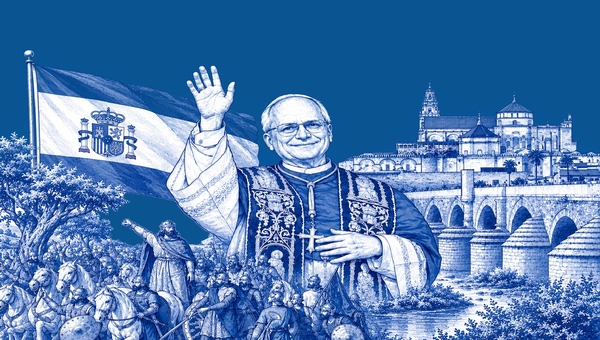
Pope Leo XIV began an official visit to Spain by urging Spaniards to embrace multicultural coexistence with Islam and stop “fanning the flames of polarization” over mass migration from the Muslim world.
Pope Leo Urges Spain to Embrace Multicultural Coexistence with Islam
Soeren Kern | Ideological Defense Institute | June 11, 2026
Pope Leo XIV began an official visit to Spain (June 6–12) by urging Spaniards to embrace multicultural coexistence with Islam and stop “fanning the flames of polarization” over mass migration from the Muslim world. He said that Christians and Muslims can live together as friends and proceeded to present medieval Spain—which was occupied by Islamic invaders for nearly 800 years—as an interfaith utopia that led to advancements in astronomy, medicine, and science.
The Pope declared:
“Your own history suggests that a culture of encounter, not confrontation, is what fosters stability and prosperity….
“The presence of Islam on the Iberian Peninsula, for example, constituted a long-standing political, cultural, and religious reality. During that period, there was not only confrontation, but also an attempt to create a space for contact, conversation and dialogue on the meaning of truth among Christians, Muslims and Jews.
“At the School of Translators enhanced by Alfonso X (the Wise), experts from all three religions collaborated on translating the texts of the rich Arabic, Greek and Hebrew heritage, contributing to the dissemination of texts such as those of the philosophers Averroes (1126–1198) and Maimonides (1138–1204), among others.
“The cities of Córdoba and Toledo, in particular, became centers of dialogue between languages, religions and knowledge. This is the truth told by European cities: their historical stratification, the fabric of solidarity that has shaped their differences over the centuries, transforming inevitable conflicts into new beginnings.”
The Pope’s remarks were greeted with significant pushback by Spanish historians, theologians, and lay Catholics. They accused him of misrepresenting Spain’s history by repeating the false claims of progressive historians that life on the Iberian Peninsula (modern-day Spain and Portugal) during its eight-century-long occupation by Muslims was a paragon of religious tolerance and harmony.
A Brief Religious History of Spain
Before examining the Pope’s comments in greater detail, some historical context may be helpful. Spain is one of the oldest Christian nations in the world. The Apostle Paul, writing in Romans 15:24-28, twice expressed a desire to preach the gospel of Jesus Christ in Spain, the farthest western edge of the Roman world.
Historians debate whether Paul ever made it to Spain, but Christianity did spread across the Iberian Peninsula after the Edict of Milan (AD 313), which granted Christians legal protection to practice their faith in every part of the Roman Empire. Christianity became entrenched in Spain after the Edict of Thessalonica (AD 380) established Nicene Christianity as the official state religion of the Roman Empire.
In AD 711, less than a century after the birth of Islam, the Moors (North African, Arab and Berber Muslims), serving the Umayyad caliphs of Damascus, invaded the Iberian Peninsula, parts of which remained occupied by Muslims for nearly 800 years. Under Islamic rule, this territory was known in Arabic as al-Andalus.
The centuries-long Reconquista (reconquest) to liberate the Iberian Peninsula from Moorish occupation began with the Battle of Covadonga (AD 718–722), when a nobleman named Pelayo defeated the Moors in northern Spain and established the Christian Kingdom of Asturias. He is considered by many to be the “founder of Spain” and the “first king of Spain.”
The Reconquista continued for another 770 years; the Islamic era in Spain did not end until 1492, when the Catholic Monarchs—King Ferdinand II or Aragon and Queen Isabella I of Castile—successfully conquered the Emirate of Granada, the last Moorish stronghold on the Iberian Peninsula, and reunified Spain under Christian rule.
Life in Muslim Spain
The Pope’s idealized portrayal of life in Spain for Jews and Christians under Muslim occupation does not jibe with historical reality. Islamic Spain was ruled by Muslim theocrats and was marked by the marginalization and repression of Jews and Christians in all areas of life.
Historians estimate that the total population of the Iberian Peninsula before AD 711 was approximately five million. The initial number of Moorish invaders numbered around 10,000 men, but continuous migration from North Africa and the Middle East over the following centuries increased to the extent that Muslims eventually became the majority in Spain.
The new Islamic social structure in medieval Spain (al-Andalus) divided the population between Muslims (umma), and non-Muslims (Jews and Christians), who were the “protected people” (dhimmis). The dhimmis, although legally protected, were second-class citizens required to pay a special tax (jizya) and accept religious and cultural repression in all aspects of life. Because they could never have equal status with Muslims, the jizya incentivized nominal Jews and Christians to convert to Islam.
Pope Leo’s assertion that life in al-Andalus was marked by peaceful coexistence is untrue. The reality, according to historians, is that the Arab Muslim invaders subjected Jews and Christians—the so-called People of the Book (the Bible)—to an existence of institutionalized prohibitions and violence.
Some Christians were able to preserve their religion, but sought to imitate Arab customs so much that they became known as the Mozarabs (those who claim to be Arabs or Arabized). Mozarabs adopted the Arabic language and approximately 50 percent of them converted to Islam by AD 950 due to Muslim social pressure.
In his landmark book, The Myth of the Andalusian Paradise, historian Darío Fernández-Morera documents the “brutality,” “brute force,” and “ruthless methods” with which the Muslims subjugated the Jewish and Catholic populations of Spain. He shows how Muslims systematically sacked Catholic cities and towns, demolished their churches, confiscated their property, enslaved them, and increased their taxes “to finance the embellishment of al-Andalus.” He further documents imprisonments, forced exiles, assassinations, and racial prejudice by Muslims against Jews and Christians. He adds:
“The existence of a Muslim kingdom in Medieval Spain where different races and religions lived harmoniously in multicultural tolerance is one of today’s most widespread myths. University professors teach it. Journalists repeat it. Tourists visiting the Alhambra accept it. It has reached the editorial pages of the Wall Street Journal, which sings the virtues of the “pan-confessional humanism” of Andalusian Spain (July 18, 2003). The Economist echoes the belief: “Muslim rulers of the past were far more tolerant of people of other faiths than were Catholic ones [November 15, 2001]…. The problem with this belief is that it is historically unfounded, a myth. The fascinating cultural achievements of Islamic Spain cannot obscure the fact that it was never an example of peaceful convivencia.”
Pope Leo’s False History Lesson
In his speech, the Pope cited four examples of peaceful coexistence between Muslims, Jews, and Christians in medieval Spain: Averroes and Maimonides, and Córdoba and Toledo. Each of these examples contradict the claim that Islamic Spain was a beacon of peaceful coexistence. Let’s examine them in chronological order.
- Córdoba. Between AD 850–859, a group of 48 Christians—including monks, nuns, and laypeople—were executed by beheading in Córdoba, the capital of Umayyad al-Andalus. Known as the Martyrs of Córdoba, they were prosecuted under the laws of the Emirate of Córdoba for a series of offenses, including refusing to renounce their Christian faith, publicly denouncing Islam, or insulting the Prophet Muhammad. For centuries the Martyrs of Córdoba were symbols of religious persecution in Islamic Spain, but some modern scholars now claim they were not martyrs but religious fanatics and troublemakers who needlessly provoked Muslim authorities.
- Averroes. Also known as Ibn Rushd, Averroes was born in Córdoba in 1126 and was an Andalusian jurist and philosopher who became universally known for his extensive commentaries on Aristotle. His work helped reintroduce Greek philosophy to Western Europe and influenced medieval Christian scholasticism. Averroes was an expert in the Maliki school of Islamic law and served as a chief judge (Qadi) in Córdoba. He tried to integrate Islamic traditions with ancient Greek thought but faced strong resistance from other Islamic jurists. His books on metaphysics and philosophy were eventually condemned and publicly burned. Averroes was banished from Spain in 1195, the same year the Almohad Caliph Abu Yusuf won a decisive victory over the Christian forces of King Alfonso VIII at the historic Battle of Alarcos. Averroes died in Morrocco in 1198 and his body was later transferred to the family tomb in Córdoba.
- Maimonides. Moses Maimonides, born in Córdoba in 1135, was a Jewish jurist, philosopher and the foremost Jewish intellectual in medieval Europe. After the Almohads, a fanatical Islamic sect, captured Córdoba in 1148, the Jews there were faced with the choice of converting to Islam, leaving the city, or be executed. Maimonides wrote a work titled “Epistle on Forced Conversion” before being forced to leave al-Andalus in 1160. He settled in Morocco and died in Egypt in 1204. Like Averroes, Maimonides was not a beneficiary of Andalusian tolerance.
- Toledo. Pope Leo incorrectly held up the School of Translators (Escuela de Traductores de Toledo) as a symbol of Islamic tolerance. The school consisted of a group of scholars who worked together in Toledo during the twelfth and thirteenth centuries to translate works of Islamic philosophy and science from Arabic into Medieval Latin and Spanish. While it is true that Toledo was a center of learning under Muslim rule, the city was reconquered for Christianity by King Alfonso VI in 1085. The School of Translators was officially established by Alfonso X in the early 1250s, nearly two centuries after Toledo had been taken over by Christians. In other words, the achievement that Pope Leo attributed to Islam was in fact an achievement of Christian Spain.
Conclusion
Millions of immigrants from the Muslim world have arrived in Spain over the past two decades and crime rates are skyrocketing. So, what explains the continuation of the false narrative that Spain benefits from mass migration?
The Spanish historian Fernández-Morera concludes:
“By any objective standards, then, and in spite of its undeniable artistic, literary, and scientific accomplishments, and of modern wishful “let-us-all-get-along” thinking that tries to gloss over evidence to the contrary, Islamic Spain was not a model of multicultural harmony. Andalusia was beset by religious, political, and racial conflicts controlled in the best of times only by the application of tyrannical force. Its achievements are inseparable from its turmoil….
“Extolling al-Andalus offers the double advantage of surreptitiously favoring multiculturalism and deprecating Christianity, which is one of the foundations of Western civilization. This mechanism is not unlike that in the mind of those who dislike Western culture intensely, but who with the fall of Communism find themselves without any clear alternative and so grab Islam as a castaway grabs anything that floats. So anyone who dislikes Western culture or Christianity—for any reason, be it religious, political, or cultural—goes on happily pointing out, regardless of the facts, how bad Catholic Spain was when compared to the Muslim paradise.”
Soeren Kern is a fellow at the Ideological Defense Institute.