Turkish Islamic Ultranationalism on the Rise in Germany
The ‘Gray Wolves,’ an influential Turkish ethno-nationalist movement, now has a record number of supporters in Germany is and is emerging as one of the largest rightwing extremist organizations in the country.
Turkish Islamic Ultranationalism on the Rise in Germany
Soeren Kern | July 18, 2026
The ‘Gray Wolves,’ an influential Turkish ethno-nationalist movement, now has a record number of supporters in Germany, according to a new intelligence report on domestic threats to Germany’s constitutional order. The group is rapidly expanding and is emerging as one of the largest rightwing extremist organizations in Germany.
The number of Gray Wolves in Germany now exceeds 13,500, which is more than four times the number of members (3,000) of Germany’s neo-Nazi party, ‘Die Heimat’ (formerly the National Democratic Party of Germany, NPD), according to the latest annual report (Verfassungsschutzbericht 2025) by Germany’s domestic intelligence agency (Bundesamt für Verfassungsschutz, BfV).
The Gray Wolves movement—known in Turkish as ‘Ülkücü’ (Idealism)—is a Turkish version of Aryanism and its exclusionary ethnic worldview opposes anyone who is not Turkish or Sunni Muslim. It is anti-Christian and anti-Jewish, as well as anti-American, anti-Armenian, anti-Kurdish, and anti-Greek.
The Gray Wolves seek to unify all Turkish peoples into an imaginary Turkish empire called Turan whose territory would stretch from Europe to China. The Gray Wolves want to establish a new world order based on Islam that is led by Turkey; they are vehemently opposed to the assimilation or integration of Turkish immigrants into Western society.
The German intelligence report explains:
“The right-wing extremist Turkish ‘Ülkücü’ movement emerged in the mid-20th century. It is grounded in an ideology ranging from extreme nationalism to right-wing extremism, characterized by elements such as racism, antisemitism, and the exaltation of Turkish identity. Its asserted cultural and religious superiority leads to the denigration of other ethnic groups and religions—particularly Jews, Kurds, and Armenians—in a manner contrary to the spirit of international understanding.
“Other targets of hostility include communism, capitalism, and ‘imperialism,’ as well as the states associated with these concepts. The goal of defending and strengthening Turkish identity, coupled with a self-image of belonging to a martial and combative people, reinforces the desire for segregation and drives social disintegration. The ideal vision is the creation of the ‘Turan’ empire—based on the concept of common ancestry—extending from the Balkans to western China, under Turkish leadership.”
Close Ties to Turkey
The Gray Wolves movement in Germany is divided into three main umbrella organizations:
- Federation of Turkish Democratic Idealist Associations in Germany (ADÜTDF, also known as ‘Türk Federasyon’) is the largest ‘Ülkücü’ umbrella organization in Germany. It represents the interests of Turkey’s far-right ‘Nationalist Movement Party’ (MHP), which is the parent political party of the ‘Ülkücü’ movement. ADÜTDF has around 160 local branches in Germany with around 7,000 members.
- Union of Turkish-Islamic Cultural Associations in Europe (ATIB) represents the Islamic-oriented part of the ‘Ülkücü’ movement. ATIB claims to have 80 branches in Germany with over 8,000 members, but German intelligence estimates that the group, which is based in Cologne, currently has around 1,200 members organized in around 25 local branches.
- Federation of World Order in Europe (ANF) is the European organization of the extreme Turkish nationalist ‘Great Unity Party’ (BBP), which is directed against ethnic minorities (especially Kurds) as well as against religious minorities (especially Christian Armenians). ANF was founded in Germany in 1994 and currently has around 15 local branches in Germany with a total of around 1,200 members.
Another 3,000 Gray Wolves in Germany belong to other ‘Ülkücü’ structures and the unorganized ‘Ülkücü’ movement, according to the report. They are mainly younger people who are in contact with one another primarily via social networks on the internet, but sometimes also meet each other personally. The intelligence report adds:
“The Middle East conflict remains a dominant topic of discourse within the independent ‘Ülkücü’ scene; here, solidarity is expressed—without exception—with the Palestinian side. Furthermore, ‘Ülkücü’ adherents frequently engage in displays involving weapons or other threatening gestures intended to project strength, superiority, and a readiness to fight. The scene’s high potential for violence becomes evident during confrontations with political opponents, such as at demonstrations.”
Youths With Identity Issues
A new report by the Federal Working Group on Religiously Motivated Extremism (Bundesarbeitsgemeinschaft religiös begründeter Extremismus, BAG RelEx), together with the Network for Islamism Prevention and Democracy Promotion (Verbund Islamismusprävention und Demokratieförderung, KN:IX), reveals that “many of the people associated with Turkish ultranationalism belong to younger generations who were socialized in Germany and often have only limited direct connections to Türkiye.”
Yet, a recent German parliamentary interpellation notes that unorganized supporters of the Gray Wolves “often behave much more aggressively on social media” where “they disseminate racist and antisemitic content, cultivate hostile stereotypes, and incite hatred—particularly against Kurds and political opponents.”
Analyst Kemal Bozay writes that the MHP, Turkey’s far-right ‘Nationalist Movement Party’ which has around 500,000 members, “represents the largest gathering place for the far-right movement in Turkey.” He notes that its youth organization, ‘Ülkücü Gençlik’ (Idealistic Youth), is highly active in Germany and that its “idealistic-militant logic” is “clearly evident” in its oath (Ülkücü Yemini):
“By Allah, the Qur’an, the Fatherland, the Flag, we swear an oath. My martyrs, my front-line soldiers [veterans], may they be safe. We, the idealistic Turkish youth, will continue our struggle against Communism, Capitalism, Fascism, Zionism, and all forms of imperialism. Our struggle will go to the last man, to the last breath, to the last drop of blood. Our struggle will continue until nationalist Turkey, until the Turan is reached. We, the idealistic Turkish youth, will not shrink back, will not waver [break down], (but we will) achieve, achieve, achieve our goals. May Allah protect and exalt the Turks. Amen.”
In addition to indoctrinating Turkish-German youths against Alevis, Armenians, Greeks, Jews, Kurds, and Yazidis, the Gray Wolves carry out intelligence-gathering operations for the Turkish government, and have murdered, assaulted, and intimidated critics of President Recep Tayyip Erdogan in Germany.
In 1995, during an annual meeting of the Türk Federasyon in Essen, Germany, the then MHP chairman Alparslan Türke? coined the term “European Turkishness” (Avrupa Türklü?ü), which serves as a collective term for supporters of the Turkish nationalist identity outside of Turkey’s borders. Bozay writes:
“It refers to people of Turkish origin who, although their lives are centered in Western Europe, are nevertheless expected to propagate their Turkish nationalist identity. This logic is also reflected in the slogan ‘Become German, remain Turkish!’, with which almost all Turkish far-right organizations in Germany urge their members to acquire German citizenship but then use it to promote supposedly Turkish national interests and build a strong Turkish nationalist lobby in Germany. The focus is particularly on recruiting Turkish-speaking youths of the third or fourth generation of immigrants who were born and raised in Germany but often struggle with identity issues. They are to be politicized and mobilized for Turkish far-right organizational structures.”
The Turkish-Islamic Synthesis
Although Turkish nationalism lies at the heart of the Gray Wolves’ ideology, Islam has an essential role: it serves as a counterweight to the influence of secular, liberal, and often pluralistic ideas. “The central implication of this ‘Turkish-Islamic synthesis’ is the notion of the inseparability of Turkish national and Islamic elements in Turkish history,” according to Bozay.
Analysts Maida Ganevic and Miriam Uludogan-Heß write:
“The so-called Turkish-Islamic synthesis refers to an ideological current within Turkish ultranationalism that views Turkish ethnic identity and Sunni Islamic religiosity not as competing forces, but as elements that are constitutively interlinked: in this context, Islam is not regarded primarily as a universal community of faith that transcends national borders, but rather as an essential component of the Turkish ‘national character’—as the religion that naturally belongs to Turkishness, so to speak….The central ideological implication of this synthesis lies in the postulated inseparability of Turkish nationality and Islamic religiosity….
“In its concrete manifestation, the Turkish-Islamic synthesis exerts a cumulatively exclusionary effect: individuals who are not considered ethnically Turkish—such as those of Kurdish or Arab origin—and/or who do not belong to Sunni Islam—adhering instead to Alevism or Yazidism, for instance—often find themselves doubly marginalized within this interpretive framework.”
The Myth Behind the Movement
The Vienna-based MENA Research and Studies Center explains the myth that underpins the Gray Wolf movement:
“Their symbol: the gray wolf. Their name: Ülkücü, Turkish for idealist. Their goal: a Turkish empire and the elimination of political opponents….
“According to legend, a wolf in pre-Islamic times led and saved endangered Turkish tribes who were from the Altai Mountains in Central Asia. The Gray Wolf is considered a powerful hunter that roams the country freely and independently. Since he lives from hunting, he will never recognize others as free and independent. The Gray Wolves movement follows this picture: All non-Turkish sections of the population, especially minorities in their own country, are ‘racially’ persecuted….
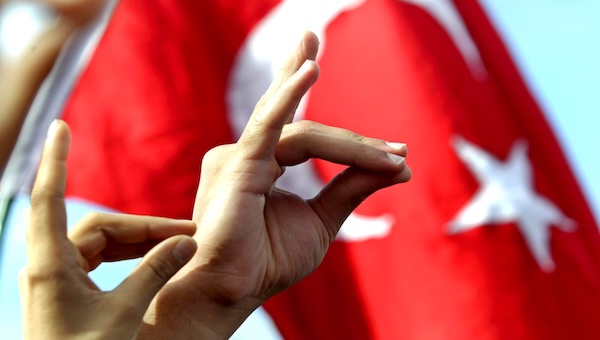
“The declared goal of the movement is the establishment of a Pan-Turanian nation that stretches from the Balkans through Central Asia to China and unites all so-called ‘Turkic peoples’ in a ‘Greater Turkic empire.’ Its symbol, the Gray Wolf, is still used as a sign of distinction today: followers greet the world with the wolf salute. In addition, the howling wolf, along with the Ottoman war flag with the three crescents, is a popular flag motif. Officially, Turkish followers call themselves Ülkücü, idealists, unofficially they are the Gray Wolves.”
Banning the Gray Wolves
Austria banned the Gray Wolf salute in February 2019. Anyone found making the gesture in public faces a fine of €4,000 ($4,550); repeat offenders face fines of €10,000 ($11,400). France proscribed the Gray Wolves in November 2020, after they defaced an Armenian genocide memorial near Lyon. On May 4, 2021, the European Parliament called for an EU-wide ban of the group:
“The European Parliament is highly worried that the racist right-wing extremist Ülkücü movement, known as ‘Grey Wolves,’ which is closely linked to the ruling coalition party MHP (the Nationalist Movement Party), is spreading in Turkey itself, but also in EU Member States; it calls on the EU and its Member States to examine the possibility of adding Grey Wolves to the EU terrorist list, to ban their associations and organizations in EU countries, to closely monitor their activities and to counter their influence, which is especially threatening for people with a Kurdish, Armenian or Greek background and anyone they consider an opponent.”
Lawmakers are warning they pose a growing threat to the country’s constitutional order, but Germany’s government has been reluctant to ban the group, apparently out of a fear of angering Turkish President Recep Tayyip Erdogan.
A German parliamentary interpellation dated June 30, 2026, noted:
“As early as the 19th legislative term, the German Bundestag advocated—in a cross-party motion—for curbing the influence of the ‘Gray Wolves’ in Germany and examining a potential ban on the organization (cf. Bundestag printed paper 19/24388). Despite this cross-party consensus regarding the threat posed by the ‘Gray Wolves,’ the Federal Ministry of the Interior (BMI) has so far taken no steps to act against the organization and its structures with the urgently needed determination characteristic of the rule of law.”
Soeren Kern is a fellow at the Ideological Defense Institute. Follow him on Substack at: https://islamicgeopolitics.substack.com/